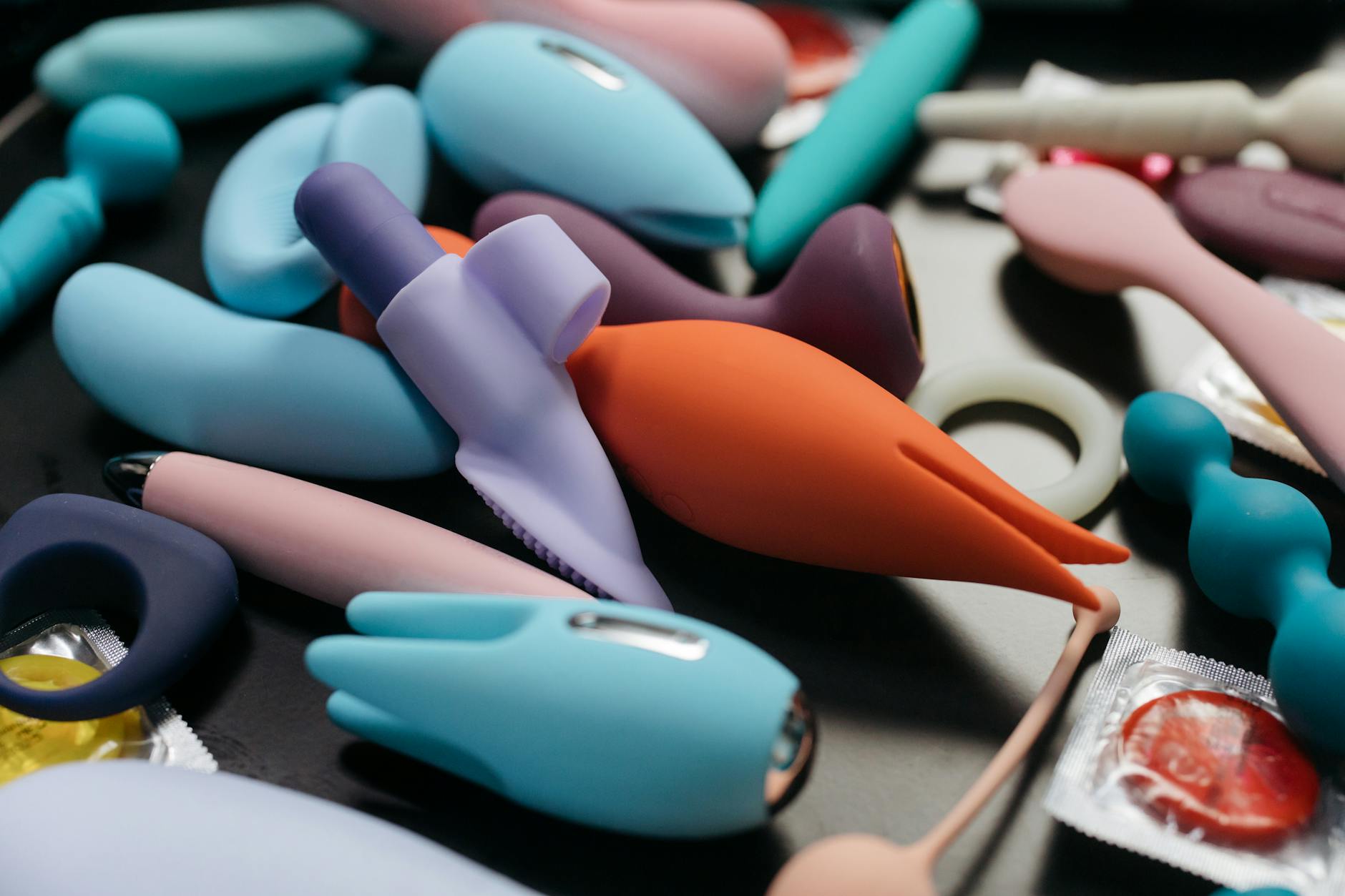
The moment you start hormonal birth control, your body begins a slow chemical conversation with synthetic hormones. These aren't subtle shifts. They change arousal pathways, vaginal pH, lubrication, and blood flow to your clitoris. Many people report that their pleasure response feels completely different within the first month or two. If you've recently started the pill, patch, ring, or implant and suddenly your go-to sensations feel off, your body isn't broken. It's just recalibrating.
The thing nobody tells you is that your lemon vibrator might suddenly feel too intense, or not intense enough, or weirdly uncomfortable in ways you can't quite name. That's not a sign to abandon it. It's a signal to adjust how you're using it.
Let me walk you through what's happening and exactly how to recalibrate your pleasure.
When you start hormonal contraception, estrogen and progestin (synthetic progesterone) flood your bloodstream at levels your body has never experienced on that particular schedule. This affects sensation in three specific ways.
First, lubrication changes. Most people on hormonal birth control experience a measurable decrease in natural lubrication, especially in the first few months. This isn't universal, but it's common enough that it's worth naming. Less moisture means your clitoris can feel less sensitive to direct touch because the protective layer of fluid is thinner.
Second, blood flow shifts. Estrogen regulates blood flow to the vulva and clitoris. When you start synthetic hormones, this system recalibrates. Some people experience less engorgement and swelling during arousal, which can make sensation feel muted or delayed.
Third, sensation itself can dull. Some hormonal contraceptives, particularly those with higher progestin doses, can reduce overall sexual desire and clitoral sensitivity. This is a documented side effect, not something you're imagining. It typically improves after three to four months as your body adapts, but the first cycle can feel genuinely strange.
A lemon vibrator's genius is its precision. The Lem's suction-based stimulation targets thousands of nerve endings in your clitoral complex with surgical accuracy. But if your clitoris is less engorged, less lubricated, or experiencing reduced sensitivity, that precision can suddenly feel either too strong or too distant.
Here's what typically happens: people try their lemon vibrator on the same setting they used before starting birth control and it feels either wildly overstimulating or completely ineffective. Both reactions are normal. Your body hasn't forgotten how to experience pleasure. The volume has just been turned down on the input signal.
Start lower than you think you need to. If you were using your lemon vibrator on setting 4 or 5 before birth control, begin with setting 1 or 2 and spend two weeks there. This isn't a downgrade. It's a recalibration.
Why start so low? Because sensation sensitivity often drops in the first month on hormonal birth control, and your clitoris needs time to adapt to the new hormonal baseline. Using a higher setting out of habit can create a feedback loop where you feel like you're not getting anywhere, when really you're just overpowering the signal.
After two weeks on setting 1 or 2, slowly increase by half a setting every few days. Notice what feels good. Many people find that their sweet spot is now one to two settings lower than before. Others eventually return to their original setting. There's no "right" number. The goal is finding what actually feels good in your new body.
If you weren't using lubricant before, now is the time to start. Water-based lube is essential with lemon vibrators because it protects your tissue and helps the suction mechanism feel less grabby on drier skin.
Apply lube directly to your clitoris and the opening of the Lem's cup. You want enough that the seal is smooth but not so much that the suction can't function. A dime-sized amount is usually enough to start.
For the first few months, lube isn't optional. Your body is adapting, and external lubrication gives you breathing room while your natural lubrication catches up. Most people find that after four to six months on hormonal birth control, their natural lubrication stabilizes and they can use less external lube. But in the early weeks, treating lube as a standard part of your routine makes a massive difference.
Arousal takes longer when you're on hormonal birth control. Budget extra time for your body to wake up before you introduce your lemon vibrator.
Instead of five minutes of foreplay or self-touch, aim for fifteen to twenty minutes. This might feel like a lot, but it's not a failure. It's just your body's new timeline. Spend this time on whatever turns you on. Touch, fantasy, audio content, visual material, or just sensation in your body without goal-oriented touch.
When blood flow finally reaches your clitoris and you feel engorgement building, that's when you bring in your lemon vibrator. Starting when your body is already partially aroused makes the vibrator's effect feel much more effective and pleasurable.
Here's the part that's purely psychological but absolutely matters. Orgasms might feel different or take longer to reach when you're adjusting to hormonal birth control. Some people report shallower orgasms in the first months. Others find that orgasms take longer to arrive but feel more intense when they do.
This is temporary. Your nervous system is learning to interpret arousal signals through a new hormonal lens. It usually stabilizes after three to four months.
In the meantime, let go of what your orgasm "should" feel like and pay attention to what it actually feels like. An orgasm that takes eight minutes instead of three is still an orgasm. One that feels concentrated in your clitoris instead of radiating outward is still valid.
If you're using a lemon vibrator with a partner, let them know this is normal and temporary. If you're flying solo, give yourself permission to explore what pleasure actually feels like right now, not what it used to feel like.
Most people notice the biggest shifts in the first two to four weeks on hormonal birth control. By week six or eight, many find that sensitivity and arousal are starting to feel more normal, though sometimes not quite baseline.
The three-month mark is when most people's bodies have genuinely adapted. If you're still experiencing significant numbness, dramatically reduced arousal, or pain at three months, that's worth talking to your prescriber about. Some hormonal contraceptives are better for sexual function than others, and switching to a different formulation can make a genuine difference.
In the meantime, your lemon vibrator is a brilliant tool for this transition. It's specific enough to work even when sensitivity is muted, and precise enough that you can use it without needing the full-body arousal response that takes longer to build.
When you start hormonal birth control, pleasure changes feel permanent. They don't usually are. Your body is undertaking a significant chemical shift, and sensation changes are a normal part of that adjustment.
One thing I tell clients is to write down how your pleasure feels right now. In three months, check in with that note. Most people are shocked by how much has shifted. Not necessarily back to baseline, but definitely forward.
If you're struggling with these changes while in a relationship, as I explore in depth in our guide on how to use a lemon vibrator with your partner without the awkward conversation, the key is separating the adjustment from the relationship itself. Hormonal birth control affecting sensation is a body thing. It's not a reflection of attraction or connection.
For a small percentage of people, hormonal birth control causes persistent sexual side effects that don't resolve. Reduced arousal, numbness, or difficulty with orgasm can continue past the three-month mark. If that's your experience, you have options.
First, talk to your prescriber. Some people find that switching to a different formulation, a different birth control method entirely, or adjusting the dose makes a meaningful difference. Others find that adding testosterone therapy (yes, it's prescribed off-label for sexual side effects, and yes, it works) helps restore sensation.
Your pleasure matters. Birth control is a valuable tool, but not if it comes at the cost of your sexual health. You deserve both reliable contraception and a body that feels good during sex.
No. Most people experience temporary changes in sensation, arousal timeline, and lubrication in the first two to four months on hormonal birth control. By three months, many have noticed significant improvement. For about five to ten percent of users, sexual side effects persist, and that's worth discussing with a healthcare provider.
Your lemon vibrator doesn't stop working. Your body's response to stimulation changes temporarily, which can make it feel less effective until you adjust intensity, add lubrication, and extend warm-up time. Once you recalibrate, most people find it works just as well as before.
Reduced sexual desire is a documented side effect of hormonal birth control, especially in the first month or two. It's not in your head, and it's not permanent for most people. If it persists past three months or is genuinely distressing, talk to your prescriber about trying a different formulation.
Most people notice their body starting to adapt by week six. The three-month mark is when significant stabilization usually happens. Some people feel back to baseline by month four or five. Everyone's timeline is different.
Absolutely. In fact, it can be easier to use a precise tool like a lemon vibrator when sensation is muted, because the specificity of the stimulation means you don't need your entire body to be in a state of high arousal for it to work.
Yes, especially in the first few months. Hormonal birth control often reduces natural lubrication, and external water-based lube makes the experience more comfortable and helps the suction work better.
Hormonal birth control changes your body's pleasure response. That's real, and it's temporary for most people. Your lemon vibrator doesn't stop working. You just need to recalibrate how you use it to match your body's new baseline.
Lower intensity, more lubrication, longer warm-up time, and patience usually get you back to a place where pleasure feels good again. By month three or four, most people find that their sensitivity and arousal have stabilized enough that they're back to their usual routine.
If you're still struggling after three months, or if you want to explore how to navigate these changes with a partner, reach out. This is a normal transition, and you deserve support while your body adapts.
Laumann, E. O., et al. (2009). Sexual dysfunction in the United States: prevalence and predictors. JAMA, 281(6), 537-544.
Maseroli, E., et al. (2016). Hormonal contraception and sexuality: impact on desire, arousal, and orgasm in women. The Journal of Sexual Medicine, 13(4), 513-522.
Cicero, V., et al. (2012). Differences in sexual function and fear of sexual contact between women with episodic migraine and episodic tension-type headache. Headache, 52(3), 456-466.
Warne, R. P., & Strauss, B. (2014). Hormone replacement therapy use and cognition in older Australian women. Menopause, 21(2), 133-142.